The Gold Coast of Western Africa, the Slave Trade to the Americas, the Underdevelopment of the African Continent 1
Reflections on a Sacred Pilgrimage to Ghana
Daniel Ries
In June 2025, I took part in the pilgrimage and mission trip to Ghana sponsored by the Urban Renewal Center and the Harris Institute. I was asked to join this group in the summer of 2024 after several engineers and I presented a STEM Camp for the Urban Renewal Center (URC) IMPACT Arts kids. The plan was to offer this STEM Camp, which involved building and launching rockets made of soda bottles pressurized with water and air as fuel. The camp required special launchers and materials packed into suitcases and checked as baggage on our flight to Ghana to avoid uncertain shipping delays.
Antipas Harris launched a mentoring program for young men from Norfolk and other cities as part of the Harris Institute, which he established in honor of his parents. His father recently went home to be with the Lord.
Upon arriving in Ghana, the first words we learned were “Akwaaba,” meaning welcome, and an appropriate response, “Medaase,” meaning thank you. There was much more to learn about this region and its history, which stretches from the cradle of civilization in the Middle East to Western Africa.
History of the Gold Coast

Muhammad ibn Musa al-Khwarizmi was a scholar during the Islamic Golden Age who produced Arabic works in mathematics, astronomy, and geography. Around 820, he worked at the House of Wisdom in Baghdad, the contemporary capital city of the Abbasid Caliphate. One of the most prominent scholars of the period, his works were widely influential in the Islamic world and Europe. He has been described as the founding father of algebra. The first identifiable mention of the imperial dynasty of Ghana was in written records was made by Mūsā al-Khwārizmī in 830. 2
After centuries of prosperity, the Ghana empire began to decline and eventually become a vassal state of the rising Mali Empire in the 13th century. The Mali empire, which was the center of wealth, culture, and learning in western Africa, was founded by Sundiata Keita. Mansa Musa, the richest man in the world, 14th-century Mali Empire, traded in gold and salt. Timbuktu was an ancient city in Ghana and later the Mali empire and was visited by Mansa Musa around 1325. 3,4
A famous account about Timbuktu was written by Leo Africanus, born El Hasan ben Muhammed el- Wazzan-ez-Zayyati born in Granada in 1485. King Ferdinand and Queen Isabel from Spain in 1492 expelled his family. His family settled in Morocco, where accompanied his uncle on diplomatic missions throughout North Africa. During these travels, he visited Timbuktu. 5
As a young man Leo Africanus was captured by pirates and presented as an exceptionally learned slave to Pope Leo X, who freed him, baptized him under the name “Johannis Leo de Medici”, and commissioned him to write, in Italian, a detailed survey of Africa. His accounts provided most of what Europeans knew about the continent for the next several centuries.5

Prince Henry the Navigator sent ships to explore the African coast in 1418. The Portuguese had several motives for voyaging south. They were attracted by stories of lands that were rich in gold and ivory. They also sought a southern route to India to circumvent Arab traders and establish direct trade with Asia. 6
Arguin is an island off the western coast of Mauritania in the Bay of Arguin. In 1445, Prince Henry the Navigator set up a trading post on the island, which acquired gum arabic and enslaved people for Portugal. 6
In 1452, Pope Nicholas V issued papal bull Dum Diversas which granted permission to King Alfonso V of Portugal to sail the world, invade, search out, capture, vanquish, and subdue all Saracens (Muslims), and pagans, and other enemies of Christ and reduce their persons to perpetual slavery. 7
In 1454 Pope Nicholas V authorized the papal bull Romonus Pontifex allowing European Catholic nati
ons to expand their dominion over discovered lands, possession of non-Christian lands and enslavement of non-Christian pagans in Africa and the new world. Empire building nations now had a green light by this Bull to occupy, conquer, and enslave the occupants of “discovered” lands. By 1455, 800 enslaved people were shipped from Arguin to Portugal every year. 7

The Portuguese reached Elmina in 1471, during the reign of King Afonso V. The Portuguese King granted the Guinea trade to Fernão Gomes. Upon reaching present-day Elmina, Gomes discovered a thriving gold trade already established among the natives and visiting Arab and Berber traders. He established his own trading post. It became known to the Portuguese as “A Mina” (the Mine) because of the gold that could be found there. 6
In 1481, King João II (John II) of Portugal decided to build a fort on the coast to provide protection for the trading post. King João sent materials needed to build the fort on ten caravels and two transport ships. The supplies were sent along with provisions for six hundred men. Under the command of Diogo de Azambuja, the fleet arrived at Elmina in 1482. Some historians believe Christopher Columbus may have been among those to make the voyage to the Gold Coast with this fleet. 6
Azambuja met with the local chief, Kwamin Ansah, and told the chief of the great advantages in building a fort, including protection from the powerful king of Portugal. During the meeting, After offering gifts, making promises, and hinting at the consequences of noncompliance, the Portuguese received Kwamin Ansah’s reluctant agreement. 6
Azambuja was named governor, and King João added the title “Lord of Guinea” to his noble titles. São Jorge da Mina took on the military and economic importance that had previously been held by the Portuguese factory at Arguin Island, on the southern edge of Mauritania. 6
In 1493, Pope Alexander VI issued the Papal Bull Inter Caetera to Ferdinand and Isabella Queen of Castile, Leon, Aragon, Sicily, and Granada. The bull served as an ecclesial affirmation of the state-sanctioned expedition and work of conquest by Christopher Columbus. A year later, in 1494, the Treaty of Tordesillas established the Doctrine of Discovery, which cemented the right of Christians to colonize non-Christian lands. 7

By the seventeenth century, most trade in West Africa concentrated on the sale of slaves and São Jorge da Mina played a significant part in the West African slave trade. The castle acted as a depot where enslaved Africans were brought in from different Kingdoms in West Africa. The Africans, often captured in the African interior by the slave-catchers of coastal peoples, were sold to Portuguese, and later to Dutch traders in exchange for goods. 6

After an unsuccessful attempt by the Dutch to capture St. George’s Castle in 1596, they succeeded in 1637 and made it the capital of the Dutch Gold Coast. The Dutch constructed a smaller fortress on a nearby hill to protect St. George’s Castle from inland attacks. This fort was called Fort Coenraadsburg. The Dutch continued the triangular Atlantic slave route until 1814, when they abolished the slave trade, pursuant to the Anglo-Dutch Slave Trade Treaty. 6
The Underdevelopment of Modern-Day Ghana
Current day Ghana received independence from colonial rule in 1957 led by Kwami Nkrumah first president of the newly formed nation of Ghana. Nkrumah spent many years working for African self-rule visiting many countries including communist China and the Soviet Union meeting with Chairman Mao, Cho En Li, Nikita Khrushchev as well as many western leaders from Europe and the United State. 8,9,10

Nkrumah said about his country “We prefer self-government with danger to servitude in tranquility.” Many leaders in the west were skeptical of the ability of Africans to self-rule. Because of his meetings with communist leaders in his quest to gain financial and political support for Ghana and African independence and self-rule, it is rumored that the United Staes CIA may have been involved with a military coup that deposed him and later his death. 9,10
During the American Civil War there was an experiment in African American former slave self-rule on Hilton Head Island where the Union Army established a town of former slaves on land owned by southern plantation owners who were Confederate sympathizers near a Union Army base established to protect the southern reaches of Charleston harbor. 11
The experiment was the town of Mitchellville, where the Union Army established the town under black self-governance which became a haven for freed slaves as the Union Army abandoned their foothold on Hilton Head Island. The experiment was a success until after the war when the land was returned to the southern plantation owners to placate southern politicians. 11
As I traveled around Ghana I saw many lingering effects of colonialism in the city of Accra and surrounding areas. The entire city is a haphazard construction site. There were many skeletons of cinder block and concrete buildings of several to many floors. Some had construction cranes attached and while there was no work ongoing look recent. But many of these structures looked long abandoned. Did they run out of money, are some skeletons prior buildings that have been stripped of walls and furnishings? It is hard to tell; many are on lots that don’t appear to be occupied or visited recently.


Next to skeletons of buildings were neighborhoods as far as one can see of village dwellings with corrugated steel roofs and walls of cinder block and clapboard scrap lumber. Little is thrown away and saved in piles that appear to be junk but may be repurposed in the future. Everything is recycled in this economy.

The effects of colonialism dot the landscape with modern multi-story apartment buildings and office buildings and malls with the latest European and American stores next to the endless village dwelling and streets lined with shacks selling everything under the sun. It appears that for most of the people the economy is run on street vendors.

Men and women carry loads on their heads, selling food and wares from the street vendors at every corner, weaving in and out of traffic. This is the mode of moving and selling wares from the marketplaces and provides a convenient way for motorists to obtain pastry, fruit, and water while traveling to and from work.

Motorbikes everywhere. Men congregate on corners on motorbike taxies called okada or achaba in many African countries. Are they the Uber transportation of the economy? Cars parked all over in various stages of disrepair and traffic chokes all streets and roads. It appears that many people have cell phones. I wonder if they can hire an okada with their cell phone?

Some roads and streets are unpaved for miles with no working traffic lights and signals. The streets are lined with open sewers that collect the run-off of rain and septic tanks and latrine pits. I have read that only 10% of the country has access to sewage collection and water treatment. The water is stored in big black plastic tanks, but I’m not clear on where the water comes from. Rain, wells or the Volta River Dam project?
The things that are difficult in most of the country like roads, traffic lights, water and commerce seem to work in rich neighborhoods but not the general community where most people seem to live. But people seem happy and go with the flow, beautiful people, the women all dressed up in dresses clean and bright despite the conditions they live in. People don’t smoke tobacco or marijuana; I only saw weed smoked in deep recesses of the marketplace.


Houses and yards in upper class neighborhoods are surrounded by tall walls, electric fences, barb and concertina wire, and broken glass shards set in cement. Graffiti painted on fences, walls and abandoned trucks “do not urinate here”. A stark indication for western people that what we take for granted where we live, like access to bathrooms, is not readily available in Ghana.

Some paved roads have speed bumps every quarter mile through villages and upper-class neighborhoods. Major public works projects like the road west out of Accra along the coast have turned miles of terrain into dirt roads. The torn-up road under construction has potholes every few feet, with sections washed out, making navigation hazardous.
Along this road on the west coast of Accra, the economy revolves around road construction equipment and roadside vendors supporting the workers. We were the only tourist bus heading to Elmina. The visible agriculture includes banana trees and corn. Where do the roadside root produce, fruit, and vegetables come from? Are they grown on farms further inland? During a trip to the interior of the country to avoid the road construction, we saw villages and small, haphazard plots of corn, bananas, melons, and root vegetables. Who owns this land? Is it owned by the people, the tribe, the state, or outside interests?


USAID (United States Agency for International Development) has been a significant partner in Ghana’s development, providing substantial funding and expertise across various sectors. In recent years, Ghana has received approximately $150 million annually from USAID, playing a vital role in areas like health, education, agriculture, and governance. However, cuts to USAID funding have created a $156 million shortfall raising concerns about the impact on Ghana’s development progress in the health, education, and agriculture sectors. 12
Ghana has been taking steps to address the funding gap and mitigate the impact of cuts. This includes directing the finance minister to find alternative funding sources and implementing measures to ensure continued progress in key sectors. Competition among world powers is playing heavily on the African continent vying for rich mineral resources that are buried in the ground. 12
In the book “How Europe Underdeveloped Africa” the author Walter Rodney describes how the effects of colonialism beginning in the 16th century has resulted in a long-lasting effect on the people of western Africa and the underdevelopment of these nations. The names used by Europeans are telling why this region was of interest to the sea-going nations of Europe. The names Ivory Coast and Gold Coast reveal how European colonialists stole the wealth of this land that included gold and ivory and stole the bodies and humanity of native people to satisfy their lust for wealth and power. 1
A Visit to Elmina Castle: Did I Walk in Rachel’s Footsteps?
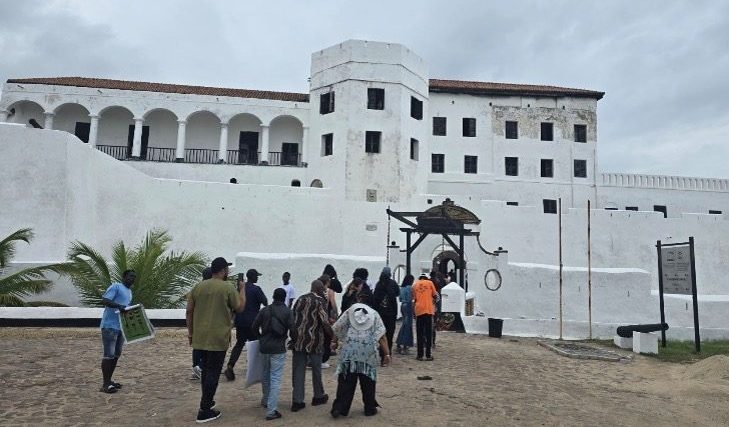
The history of this region is telling. The site of Elmina Castle, St. George’s Castle of the Mine, was first reached by the Portuguese during expeditions sponsored by Prince Henry the Navigator under King Afonso V in 1471. This area was already a hub for trade in West Africa, including gold, ivory, and enslaved people.
Fernão Gomes discovered a thriving gold trade at the site and established a trading post called A Mina, meaning “the mine,” for the local mines. In 1481, King João (John) II of Portugal built a fort at the site to protect the gold trade, naming it St. George’s Castle of the Mine. The Portuguese also built a Catholic church in the courtyard above the slave dungeons.
The Dutch later explored the Gold Coast of Africa and attempted to take over the Portuguese holdings at Elmina. They succeeded in 1637, converting the Portuguese Catholic church into a Dutch Reformed Church.
At Cape Coast Castle, located east of Elmina, another slave castle was established in 1650 by Hendrik Caerloff for the Swedish Africa Company. The first building at this site was erected in 1653, with the agreement of the local chief, and was named Carolusborg after King Charles X of Sweden.
The Danes established another fort, Fort Frederiksborg, in 1661, just a few hundred meters from Carolusborg. The English captured Carolusborg in 1664 during the lead-up to the Second Anglo-Dutch War and fortified the fort, which they named Cape Coast Castle, to such an extent that both the Danes and Dutch deemed it impossible to conquer.
Like Elmina Castle, the English built an Anglican church at Cape Coast Castle, located above the slave dungeons. Each of these Gold Coast slave castles had a Christian church above the slave dungeons, which were a key part of the slave trade in West Africa for over 350 years. Supported by several Papal Bulls establishing the Doctrine of Discovery, the Christian Church was complicit in the sin of slavery.
As I walked around Elmina Castle, I thought about the enslaved girl Rachal, owned by Lynnhaven Parish in 1767 and sold by the church. Walking on the stones of the castle, I wondered if Rachel and her family had walked on the same stone floors of Elmina. I asked myself, “Did I walk where Rachel walked?” As the tour guide described her ordeal, I thought about what Rachel and her family might have endured.

Kidnapped from her village, shackled and forced marched to a stone dungeon. Languishing in filth and abuse for 3 months that seemed an eternity in hell. Those who resisted their imprisonment were sent to an unventilated stone cell with no windows as punishment. Scratches on the stone wall testify to the life-threatening conditions in the cell. Most did not survive this punishment.

The governor of the castle could see the enslaved women from his quarters above the slave dungeons as they were periodically washed in the courtyard. The governor would pick one woman and have her brought to his bedroom next to his living quarters for his family. This practice was carried out by both Portuguese and Dutch governors in view of a Portuguese Catholic Church and later a Dutch Reformed Protestant Church located in the courtyard above and below the governor’s quarters. the slave dunge


Washed down to remove the filth in exchange for another filth, up the stairs to the governor’s bedroom. Back down the stairs to filth and disparity. Wading in her excrement, vomit and sweat, breathing fetid stale still air.


Then being herded to the place of no return, seeing her family for the last time, through the door of no return to another hell.


Chained and packed like cordwood, stacked in a layer cake of humans, feces, vomit, and sweat. She was strong and resilient, resisting disease and the temptation to take her own life, lucky enough to avoid being thrown to the sharks. Six weeks of nearly starving, seasickness, and being surrounded by others in the human layer cake, some of whom had perished.
Arriving in the West Indies at the Walke plantation in Barbados, she worked on the sugar plantation under hot, humid, brutal conditions where survival was measured in months. Then she was shipped off to Virginia to a tobacco plantation and later sold to Lynnhaven Parish.
How did she serve her masters of the church? Why was she sold by the vestry, and to whom? Was it a Thorowgood or a Walke? Did she taste freedom near the end of her life? Who did she love, and did she have children? I hope to meet Rachal as one of the five people I will meet in heaven. I will tell her I am sorry.
A Mission Trip to Two Schools and a Visit with the Tribal King of Winneba
Part of this pilgrimage was a mission to two schools to meet the children, present some concepts in physics and engineering, and build and launch water- and air-pressurized rockets. The goal was to show the children that they could pursue science and technology and see themselves in those roles. We visited two schools in the village of Winneba: one was a public school, and the other a private school.


We were greeted at each school by crowds of children and adults, over a hundred at both the public and private schools in the village of Winneba. Each school put on a well-coordinated program of native dance, accompanied by loud African music from large speakers and powerful amplifiers.


The kids and adults pitched in and built two dozen rockets at each school. We launched many, but due to time constraints, we did not launch them all. Because of the throng of children surrounding us we could not present Newton’s Laws or the Bernoulli Effect, which was the original goal, but the kids had fun and saw how science and engineering can make things happen. I would have liked to spend more time with them to present the principles that made the rockets work and I hope they can see themselves in the role of a scientist or engineer.
Local protocol calls for outside guests to visit the local village tribal king to show respect and to obtain permission for the visit. Our visit to the local tribal king was delayed by our late arrival to the following day between the visits to the two schools.
The second morning, June 24, 2025, we were received in audience by King Neenyl Ghartey VII of Winneba. The people in our group introduced themselves, and the King and his court officials welcomed us to Winneba.

It has become a tradition for the King to offer an African name to visitors with African ancestry or other interested individuals for a small fee. When it was my turn to introduce myself, I told the King about my church, the Lynnhaven Parish of Virginia, and our records of the enslavement of the girl Rachal. I explained that Rachal was a white person’s name given to her, not her real African name, and asked the King if he would honor Rachal by providing her with an African name. I would be honored to pay the fee for her name. I had no idea how the King would respond to this request, but I felt compelled to ask.
End Notes
-
Rodney W. (1972). How Europe Underdeveloped Africa. 2009 Edition, Howard University Press.
-
Al-Khwarizmi (2025, July 28) In Wikipedia https://en.wikipedia.org/wiki/Al-Khwarizmi
-
Ghana Empire (2025, July 28) In Wikipedia https://en.wikipedia.org/wiki/Ghana_Empire
-
Mali Empire (2025, July 28) In Wikipedia https://en.wikipedia.org/wiki/Mali_Empire
-
Timbuktu (2025, July 28) In Wikipedia https://en.wikipedia.org/wiki/Timbuktu
-
Elmina Castle (2025, July 28) In Wikipedia https://en.wikipedia.org/wiki/Elmina_Castle
-
Charles M. & Rah S. (2019). Unsettling Truths: The Ongoing Dehumanizing Legacy of the Doctrine of Discovery. Inter Varsity Press. https://www.ivpress.com
-
Gains K. K. (2006). American Africans in Ghana; Black Expatriates and the Civil Rights Era. The University of North Carolina Press.
-
Kwame Nkrumah Mausoleum (2025, July 28) In Wikipedia https://en.wikipedia.org/wiki/Kwame_Nkrumah_Mausoleum
-
Personal observation of exhibits at the Kwame Nkrumah Memorial Park and Mausoleum in Accra, Ghana June 2025
-
Mitchelville: One Town’s Blueprint for Reconstruction (2025, July 28) In American Battlefield Trust https://www.battlefields.org/learn/articles/mitchelville-one-towns-blueprint-reconstruction
-
Ghana scrambles to cover $156 million shortfall after US aid freeze ((2025, July 28) In Business Insider Africa https://africa.businessinsider.com/local/markets/ghana-scrambles-to-cover-dollar156-million-shortfall-after-us-aid-freeze/40nqzvz